


Development
Code + Unit Tests

Test case design
QA test cases

Manual QA
Exploratory testing

E2E Automation
User journeys tested

Performance Testing
Traffic + load validation

Release Gate
Full validation before production
Testing isn't a phase. It's how we build.
Our developers write tests as they code. Our QA engineers design test cases, run manual validations and maintain the automation process that catches everything else, long before it reaches your users.
The Problem
What Happens When Testing Is an Afterthought

Bugs reach production
Manual testing catches what it can. But regressions slip through, hotfixes pile up, and your team spends more time firefighting than building.

Releases slow down
Without automated validation, every deployment becomes a risk. Teams delay releases, stack up changes, and increase the blast radius of every push.

Confidence erodes
When no one trusts the release process, shipping becomes stressful. Developers hesitate, stakeholders lose patience, and velocity stalls.
Our Approach
Quality Engineered In — Not Tested After
Quality at Collatzinc isn't a handoff between development and QA. It's a shared discipline that runs through the entire engineering workflow — with developers and QA engineers each owning their part.
Our developers own their unit tests
Every developer writes and maintains unit tests alongside the features they build. Testing isn't something that happens after development — it's part of development. A feature isn't considered complete until its tests pass.
Our QA engineers design structured test cases
Before and during feature development, QA engineers define test cases around expected behaviour, business logic, and edge cases. This isn't ad hoc - it's deliberate, documented, and tied to acceptance criteria. Test cases are designed to cover both the happy path and the scenarios most teams overlook.
Manual testing happens where it matters
Not everything can or should be automated. Our QA engineers run manual testing cycles — exploratory testing, usability validation, and edge case investigation that require human judgement. What they find feeds directly back into the automated suite, so the same issue is never missed twice.
Automation handles the rest
Regression testing, smoke tests, performance checks, and release gates run automatically on every commit, every merge, and every deployment. No manual intervention, no missed steps.
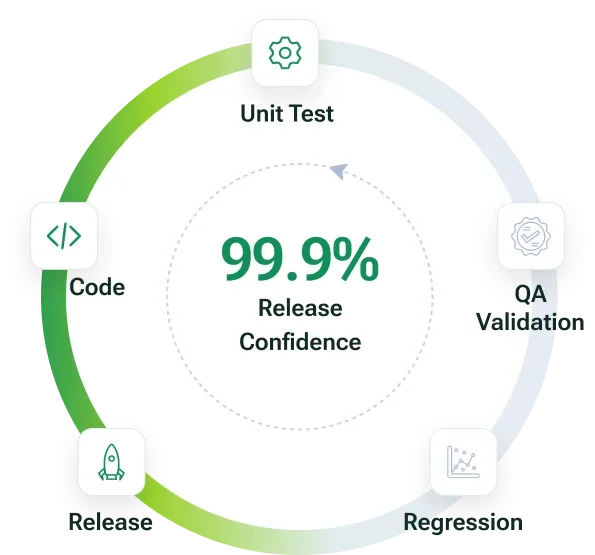
The result is a layered quality system where developers own unit-level quality, QA engineers own test strategy and manual validation, and automation handles repetitive checks at scale. Nothing slips through the gaps.
Release Stability
99.9%
Across client deployments
Testing Layers
4
Unit · Manual · E2E · Performance
Validation
Automated + Manual
Developers and QA engineers, working in parallel
What We Deliver
Quality Engineering and Software Testing Services

Code Linting and Static Analysis
Automated code quality checks integrated into CI/CD pipelines.
Every line of code passes through automated linting and static analysis before it moves forward. Developers run linting locally while writing code and the same rules run again in the CI/CD pipeline. Non compliant code never reaches a merge request. This process detects syntax errors, code style violations and potential bugs before testing begins.
Tools: ESLint, Prettier.

Developer-Owned Unit and Component Testing
Unit and component tests written and maintained by developers.
Developers write and maintain unit tests alongside the features they build. Functions modules and UI components are validated in isolation so defects surface early in the development cycle. A feature is complete only when its tests pass.
Tools: Jest, Vitest, React Testing Library, JUnit.

Test Case Design and Management (QA-Led)
Structured test cases based on business logic & acceptance criteria.
QA engineers design test cases around expected behaviour, business logic edge cases and acceptance criteria. Test cases are created during development not after release. This approach ensures strong coverage and provides clear documentation of what has been validated.

Manual Testing and Exploratory QA
Human driven testing for usability validation and edge case discovery.
Not every scenario should be automated. QA engineers run manual testing cycles for usability validation exploratory testing and edge case discovery that requires human judgement. Insights from manual testing feed directly into the automated suite so the same issue is not missed again.

AI-Generated Test Cases and Test Scripts
AI assisted test generation across the testing lifecycle.
AI accelerates test coverage by suggesting test cases based on feature requirements, business logic and edge case patterns. QA engineers review, refine and approve each case before it enters the suite. AI also generates unit and end to end test scripts that engineers validate and integrate into the automated pipeline.

End-to-End Testing
Full user journey validation across browsers, devices and environments.
We simulate real user journeys across the application from login to checkout and from form submission to dashboard rendering. Workflows are validated across browsers, devices and environments to ensure consistent behaviour for every user.
Tools: Playwright, Appium.

Performance and Load Testing
Application performance validation under real and peak traffic conditions.
Applications are stress tested under realistic and peak traffic conditions to identify bottlenecks before users encounter them. Testing includes load simulation response time benchmarking and throughput analysis.
Tools: JMeter, custom load scripts.

Automated Smoke Testing and Build Validation
Automated deployment checks that confirm application stability.
Every deployment triggers automated smoke tests that confirm the application is functional before it reaches staging or production. Failed builds are detected immediately so broken releases never move forward.

Regression Testing
Automated regression suites that protect existing functionality.
Automated regression suites run with every code change to ensure new features do not break existing functionality. The test suite grows with the product which improves reliability with every release.

Release Validation and Reliability Assurance
Final validation before production release.
Before any release goes live we run a full validation cycle across functionality performance and security. This release gate confirms production readiness and allows teams to ship with confidence.
See It in Action
This is what our automated end-to-end testing looks like in practice: a live run from an active client project.
Technology Stack
Testing frameworks integrated into CI/CD pipelines for continuous, automated validation at every stage.
Linting and Static Analysis

 ESLint
 Prettier
Unit and Component
 Jest
Jest Vitest
 React Testing Library
 JUnit
JUnit
AI-Assisted Testing
- AI-generated test cases and test scripts, validated by QA engineers before integration.
End-to-End
 Playwright
 Appium
Performance and Verification
 JMeter
- Automated smoke testing
- Build validation pipelines
CI/CD Integration
- Testing frameworks integrated into automated CI/CD pipelines.
- Tests run on every commit, merge request and deployment.
Why Embedded Quality Engineering Works

Defects cost less
A bug caught in a developer's unit test costs a fraction of one caught in production. Embedded quality engineering shifts the cost curve left.

Releases get faster
When developers test as they build and QA validates in parallel rather than sequentially, releases move faster with less risk.

Products improve with every sprint
Growing test case libraries and regression coverage mean your application gets more stable over time, not less.

Your team builds instead of firefights
When developers own unit quality and QA owns the broader test strategy, everyone focuses on moving the product forward instead of chasing bugs.
Related Services

Custom Web Development
The applications we build come with testing baked in from day one. Developers write unit tests alongside every feature, not as an afterthought.
Learn More
Cloud and DevOps
Automated testing pipelines are embedded directly into your CI/CD infrastructure for continuous validation.
Learn More
Mobile App Development
Cross-platform mobile testing with Appium ensures your iOS and Android apps are release-ready on every device.
Learn More
AI and Data Intelligence
Model validation, data pipeline testing and output verification for AI-powered systems that need to be right every time.
Learn More